

Last week, my friend Greg DeKoenigsberg posted an article about Jaron Lanier's negative comments regarding open textbooks. At almost very same time, I happened to stumble upon an article Jaron wrote back in 2006 criticizing Wikipedia.
The common theme is Jaron taking issue with what he calls "online collectivism," "the hive mind," and even "digital Maoism" (ouch!). You might call this same concept "crowdsourcing" or "the wisdom of crowds." It's all in the eye of the beholder, but the guy clearly does not have much love for wikis or the works of collective wisdom they create.
So I had to ask myself: Why so negative, Jaron?
Is Jaron really a hater of free culture, as Greg claims in his article? Is he an enemy of the open source way? Or is he just a smart dude warning us about the risks of taking the wisdom-of-crowds concept too far?
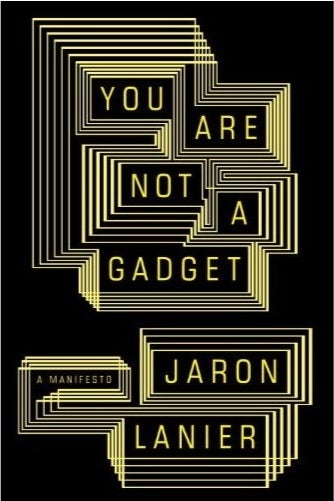 Fortunately for us, Jaron published a book earlier this year entitled You Are Not A Gadget. So I took a few hours and read it last week to see if I could answer some of these questions.
At times, the book is scary smart, with precise analysis from a man who clearly questions everything, and is in a better intellectual position to do so than most (the section on social media and its redefinition of friendship is especially interesting).
At other times it read like a college philosophy term paper. And occassionally, especially toward then end, it devolved into nearly unintelligeble (at least by me) ravings about things like "postsymbolic communication" and "bachelardian neoteny" (Michael Agger's review in Slate calls him out for this too).
But wait! Right near the beginning of the book, I found this paragraph:
"Emphasizing the crowd means deemphasizing individual humans in the design of society, and when you ask people not to be people, they revert to bad, moblike behaviors."
Hey... I kinda agree with that...
I've even written about why the term crowdsourcing bugs me for that very reason. From my crowdsourcing post: "Open source is not about people becoming part of a collective and creating a collective good for the sake of all. It is about people with selfish interests finding others with similar selfish interests and realizing they could get more work done more quickly by working together."
To me, this is one of the main things that makes the open source way very different than socialism, and makes it much more like something Ayn Rand might dig.
Jaron is definitely channeling Ayn Rand when it comes to his belief in the importance of the individual creator, which explains why he dislikes Wikipedia so much. I think he makes some good points, especially regarding the dangers of anonymous authorship (leads to lack of accountability) and the need for transparency in authorship (certainly not one of Wikipedia's strengths).
Overall, he actually does a fairly balanced job explaining the strengths and weaknesses of the crowdsourcing model. And It turns out that Jaron doesn't hate the crowdsourcing concept at all. He actually kind of likes it, but just thinks we need to be very careful about where we do and don't use it as a tool, and that we should never let the crowd ask the questions.
In fact, he fesses up to his own hyperbole at one key point in the book:
"To be fair, open culture is distinct from Maoism in another way. Maoism is usually associated with authoritarian control of the communication of ideas. Open culture is not, although the web 2.0 designs, like wikis, tend to promote the false idea that there is only one universal truth in some areas where that isn't so."
So why did you call it "Digital Maoism" then, Jaron? To get attention? Not cool.
Apparently Jaron doesn't hate open source either. At one point in the book, he declares "I'm not anti-open source. I frequently argue for it in various specific projects."
Yet he asserts that the open source movement has done nothing more than simply recreate things that were already invented, like the encyclopedia, or Linux as a derivative of UNIX.
He totally whiffs on the point of open source. Open source isn't revolutionary because of feature/function innovation. It is revolutionary because it sets things free that never had freedom before.
The open source way set the encyclopedia free through Wikipedia. It set UNIX free through Linux. It is the great democratizer, giving power and access to people who had none before.
But I digress.
I think I understand Jaron Lanier better now. To answer my original question, yes, he is a hater. Often negative, often alarmist. But also extremely thoughtful. Wickedly intelligent.
Sun Tzu told us we should not just know ourselves, but also our enemy. I'm not sure Jaron Lanier is really an enemy of free culture, more of a loud devil's advocate. I think he is a smart guy crying "fire" in a crowded theater.
But yes, we probably should be paying attention.




9 Comments